
Quill English Policies and Procedures
In this section, we’ll lay out a detailed framework for running a world-class language program. There are infinitely many kinds of beautiful lives; however, all happy families are alike in many ways. What follows is one way to organize a thriving educational experience.
We think a minimum of 4 hours of weekly classroom practice, spread out over 3-4 sessions on different days, can provide good results if maintained throughout elementary school. 7.5 hours of weekly classroom practice is excellent, is our standard planned program at Quill English Academy, and should lead to comfortable fluency.
Being able to read primary-language youth literature, thoughtfully discuss it, and write insightful compositions about it is our favorite way to frame the goal of ‘fluency’.
- First Steps: Levels 1 and 2
- Communication Books
- Levels 3+ Policies and Procedures
First Steps: Levels 1 and 2
While it is possible to conduct a truly immersive, 100% English experience, we believe that is not the optimal approach unless you’re an ESL student, learning a foreign (to you) language in a culture that uses the target language primarily. In other words, full immersion is best, but only if you actually need the target language to survive in the culture you’re living in.
“Holistic Immersion” is our philosophy.
Day 1 Checklist:
- Share some smiles
- Playfully greet your students on their level, as equals
- Learn their names
- Consider letting them sit where they please, unless needs arise that require attention
- Show them how to sit properly (Have fun with showing them how to sit improperly =)
- Start learning about who they are
- Get a few more laughs
- Show them you care – start slowly building the trust necessary for a great classroom
- Get them comfortable repeating after you and following your directions
- Lay the foundations for your classroom vocabulary – begin expanding the communication window
- Show them you can laugh at your mistakes (like trying to get all their names on the first try, perhaps!)
- Hand out books
- Read a story, play a game, have fun!
Communication Books
We believe that maintaining their own communication books is a very valuable experience for young learners. These books are a record of progress and the primary means of maintaining clear communication between school staff and primary caregivers.
Every day, students should write as much of their own communication book as they are capable of. In Level 1, some will need a lot of support, so write a bit for them until they see what’s expected of them. Show them what great work looks like. They’ll be doing it by themselves in no time.
Don’t hesitate to erase their work with a smile and help them to write it better. Do this early and often: the longer something is done poorly, the harder it is to change the habit for the better. The more you’ve given tacit consent for a behavior, condoning it by virtue of not immediately addressing it, the harder it is for a student to accept and respect your sudden change of heart.
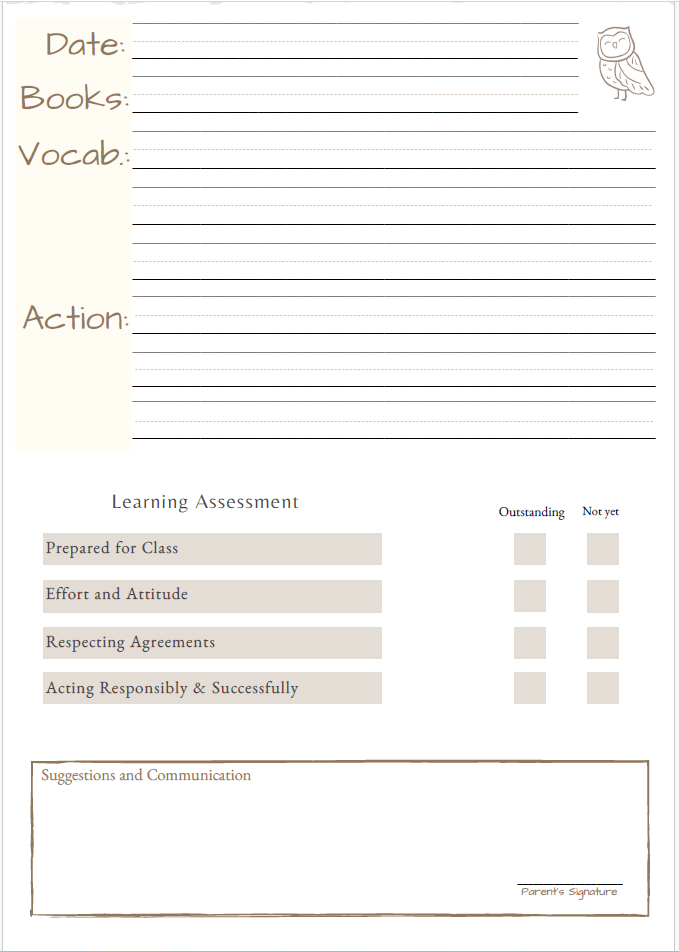
Our Communication Books have been steadily streamlined to their present form. Their present iteration should take a student about 5 minutes to write, and a minute or two per student for their teacher to review. Taking a moment to connect personally, making sure each student can read (and at least mostly understand) the day’s vocabulary, briefly reviewing the day’s successes, and supporting them through the challenges are great ways to use class time.
An “Outstanding” mark represents both impressive
progress that exceeds the instructor’s expectations and reasonable progress that shows effort and generally
meets criteria. Exceptional progress, substantial improvement, and wonderful work merit high praise. Especially outstanding work should be mentioned in the comments! An “Outstanding” mark acknowledges a student’s smart, hard work. It’s a high-five, a pat on the back, and a smile. It’s what most students deserve, most of the time. Think of how much harder these kids work than we did at their age. They are awesome.
A “Not Yet” mark represents progress deemed
unacceptably low by the instructor. “Not Yet” should
typically indicate a serious lack of effort that a teacher believes can and should be immediately and significantly remedied. We cannot fault someone for being unable to do what they cannot do, so by marking “Not Yet”, we believe that something can surely be done to remedy the issue.
It indicates that without significant attention being put into a given area, the student’s growth and/or the shared classroom experience will likely be significantly hampered.
Occasional “Not Yet” remarks aren’t necessarily serious, if given in a convivial spirit. Repeated over time, “Not Yet”
it is an urgent request for further dialogue and assistance to bridge a troublesome gap in a student’s development in which the teacher has been unable to make significant acceptable progress on their own.
Action takes the place of the usual ‘homework’ idea. One thing that we expect of our students is to make English a part of their lives outside of the classroom. As part of our daily communication books, we suggest an Action for students to take on their own time. These Actions can arise and take shape from many different situations, including:
- a fun way to *use* one of the day’s vocabulary words in order to improve or explore their daily lives
- if assigned work remains unfinished
- if there’s some coloring or design work left to do on a project
- if there’s a holiday or activity coming up that students are asked to prepare for
We know how busy students are these days and
we do our best to maximize learning time while in Quill while minimizing the amount of work students are expected to complete outside of class. That said, assigning even small amounts of activities for Actions on the order of a few minutes daily serves many useful functions, including:
- Incentivizing students to work harder in class, therefore minimizing the amount of written work they will have later;
- Presenting students with the opportunity to develop responsibility, self-control, time management, and integrity;
- Offering students the opportunity to collaborate and seek peer-to-peer reinforcement outside of the class, where they are able to communicate more freely and learn from each other;
- Aiding students in being more self-directed in their work, moving the locus of control closer to the student;
- Allowing students to be more creative as they often have access to a wider variety of personal, digital, and social resources to supplement their work;
- Helping them bring English into their lives and outside of the confines of the classroom;
- Freeing up class time for language-related tasks: we’ll be doing a lot of art and half a class spent coloring isn’t usually ideal;
- Giving us another chance to have fun with our language learning experience =)
For young learners in grades 1 or 2, the first year of English classes should be relatively light and easy, focusing on basic vocabulary, reading stories together, basic phonics, and lots of games. Beginning in our Level 3, which would be the third semester, we’ll begin a more rigorous approach.
Level 3+ Quill English Policies and Procedures
The Big Picture: Teachers are expected maintain a safe, clean, ordered, joyful, and inspiring classroom. Occasional divergences can be very much called for, except on the issue of physical safety.
Beginning Class: Every day, begin class with attendance. Lateness merits explanation; one more opportunity to use past tense verbs and discuss something relevant. Teachers are encouraged to make attendance fun and begin with a sentence pattern or something else engaging for students to say in lieu of merely acknowledging their presence.
Begin the lesson with some relevant discussion. A sentence pattern pertaining to the topic for the day is a great way to do it; some current events would be superb; or perhaps a brief personal story from your life, encouraging students to participate with their own. Start class fun, engaging, and relevant, trying to get as much participation as is enjoyable.
Vocabulary: Write the daily vocabulary words on the board as they come up in discussions or in the reading. Discussing some key words beforehand and giving them the chance to infer the meanings from the contexts are both useful methods.
Energetically seize opportunities to add words to the daily vocabulary list. Any word that came up in a discussion or in the book work that some students might not know in English is a good candidate. Any word that was directly translated on that day is a great candidate. Just two or three vocabulary words per day isn’t enough, but 20 vocabulary words is far too many for most single 60 or 90-minute classes.
Make sure students copy the day’s vocabulary words neatly and accurately into their communication books at the end of class.
Book Work: There are many different ways to approach the textbook reading, but students in lower grades should always move a finger (or another fun space-marking device) along where they are reading.
For passages of average difficulty, if time permits, we suggest: One student -> Teacher -> Whole class
For classes ready for some additional zest, one game is to allow students to add anything they’d like onto the end of sentences they read, so long as it’s grammatically correct. So if in the book the sentence is, “The heat from lava can burn almost anything,” a student might read, “The heat from lava can burn almost anything in the kitchen, just like Teacher when he cook!” With a laugh, you’ll remind them to add the ‘s’, they’ll say it again, and the class will enjoy reading and repeating all the more.
One strategy for students writing book work, as we’ve mentioned before, is allowing students to check together
after diligently attempting all the work on their own, and then collecting all of the books for a final check yourself. This is increasingly viable as students get older and isn’t usually recommended for the youngest learners, who are less likely to benefit from it.
Some teachers employ the time-tested strategy of red ink clearly indicating correct answers. This is especially prevalent in Taiwan. We suggest employing a strategy that’s more challenging for teachers and students alike: showing students where to look again, circling mistakes in pencil that can be easily erased, perhaps with a small hint, without telling them precisely what they should have done. This may require teachers to check a simple answer several times, and isn’t always feasible.
As much as possible, don’t feed answers to your students –
try to help them develop the skills to succeed on their own!
Workbooks: While we do not emphasize the value of our “book work” as much as other programs, it is important that they are completed neatly and accurately. Check them thoroughly, expect excellent work, and consider times when many students have similar problems as important teachable moments for future classes. Make notes about this in your Teacher’s Log.
It’s common in Taiwan for students to trace over a teacher’s corrections, thus demonstrating their connection to accuracy, at least somewhat. We don’t recommend this for several reasons:
- Foreign teachers tend to write quickly and less neatly than we hope students will;
- We want students to be producing correct answers themselves;
- We are aware of how simple and dry the textbooks are, and don’t want to unduly emphasize their importance;
- The symbolism of just ‘copying what teachers do’ is natural, to a degree, but somewhat counterproductive in our educational philosophy.
Extra Time: Students should usually be investing their extra time wisely. Reading a graphic novel from the bookshelf, doing some other English work, playing a quiet review game with a friend, working on their journals, drawing a picture, etc., are potentially reasonable investments of class time when you are not doing something together as a class.
Helping students be self-directed learners is crucial and will help free up time for you to work with students who need more help.
That said, a bit of daydreaming from time to time is a tremendously noble endeavor.
Daily Quiz: Every normal class, just before their break time, a brief spelling quiz should be given to students. On Mondays, we suggest a ‘warm-up’ spelling test, copying mistakes just once. Consider offering special rewards to young learners for early excellence.
As the week progresses, we suggest progressively increasing how many times students are asked to copy mistakes they continue to make. This is not punishment. It’s a learning strategy. Prizes are awarded, as always, at
Teacher’s discretion.
For the daily quizzes, mixing up the order and sprinkling in some of the older, challenging words is recommended. This is especially valuable later in the week, when scores should be good, and the test is becoming easy.
At the end of each daily quiz, ask students to copy a simple question or two and write grammatically correct answers.
Having a sentence question-and-answer activity to finish the daily quiz is highly recommended: spacing out the timing at which students finish, we are able to correct their quizzes immediately with less of their break time
spent languishing in long lines waiting for us to finish.
Daily Quiz Corrections: Students are expected to copy words they spell incorrectly and copy both the question and the answer for the final sentence. This copying should be completed daily. Check the previous day’s copying when the daily quiz is being checked (usually before break time). It should be sequentially entered in their notebooks. Any incomplete copying counts as an unsuccessful Action – all written Actions must be complete before class begins.
Extra copying as a penalty for uncopied or messily copied work is highly recommended.
Since we do not want to discourage students from trying to write something interesting for the final open-ended question, as they are typically only penalized if they are wrong, everyone should always copy the final question and answer once *unless*perhaps they write something particularly long and/or interesting. This can encourage students to write longer, more meaningful answers rather than incentivizing them to write the simplest correct answer they can.
Not doing the daily quiz corrections neatly and accurately counts as an unsuccessful Action. Habitual incompleteness is unacceptable and should be noted in communication books and discussed with both the student and school leadership.
Monthly Test: At the end of each month, consider a cumulative assessment for the primary purpose of ensuring a baseline of retention and alerting teachers to a particular group’s needs. These should be prepared beforehand by school leadership and distributed to teachers on the day of the test. We suggest not reviewing anything with the class before the test is given to more accurately assess each student’s learning progress. The test should be slightly longer than a daily quiz and should be administered before the daily work has begun.
Level Exams: At the end of each semester, there should be a cumulative assessment for the primary purpose of ensuring each student’s readiness to progress to the next level. These should be prepared beforehand by school leadership and distributed to teachers on the day of the exam. They should be treated seriously. Again, we suggest not reviewing anything with the class before the exam is given to more accurately assess each student’s learning progress. The exam should take most of the class period and should be administered immediately after class begins. Teachers should prepare some focus activity for students to engage in after their exams are completed.
Break Time: A 5-10 minute break time should typically begin after teachers check the daily quizzes. Breaks are a privilege, not a right. They should be earned every day with earnest, thoughtful work. Class rules should still be followed. Students are allowed to drink water and use the bathroom any time they need to, but it’s good to encourage them to plan ahead and do so on their breaks.
Journals: Our Quill English Journals are an integral part of our curriculum and the practice of journaling should be treated appropriately. The textbooks we use are important, useful learning tools, but the journals provide a unique opportunity to personalize the learning process, moving the locus of control closer to the students than in any other aspect of our curriculum. As journals peer into the hearts, minds, and lives of our students, we must treat them with due dignity and respect.
Class time can be allocated for their weekly journaling, after a day’s book work has been completed. This is especially important in the earlier levels, when journaling in a foreign language is more difficult. They’re a great way for students to use their extra time. Encourage them to employ translation software (more on this below), ask their classmates, or ask school leadership for assistance.
Constantly show your gratitude for their honesty, and encourage them to be as serious, down-to-earth, imaginative, or as silly as they’d like. After all, that’s what journals are for!
Journals should be collected at the beginning of every week, typically on Monday. Teachers should have them checked and returned to students as soon as possible – no later than Thursday. Expect significant improvements and great work. Uncopied journals and unsigned journals count as an unsuccessful Action.
Actions: Typically, give students one full week (7 days from the beginning of each class, to be precise) to complete each written Action assignment before considering it unsuccessful. In this way, assignments from the previous class using the same book will be completed before the subsequent lesson begins.
If a fixed due date is necessary, make that clearly part of the assignment and ensure that students record it in their communication books. Written Actions are always due
precisely at the beginning of class. Last week’s written Action is not to be hurriedly completed after class begins.
If a lack of effort and/or poor time management is becoming evident, communicate that in their communication books. Communicate promptly with parents and administration for habitual issues.
Communication Books: Communication Books must be written neatly, typically at the end of class. These books are another integral tool we employ and should be treated appropriately. They provide a running record of student achievement, challenges overcome, and vocabulary for (what must be) regular review.
Most importantly, they form the bridge between Teacher, Student, School Leadership and Family.
Students should write as much of their own communication books as possible. Self-assessment (with a pencil) is encouraged as soon as a student is comfortable, to facilitate discussion on potential discrepancies. You might find that many young learners judge themselves much more harshly than you would. Be generous, constructive, and supportive while offering useful suggestions for improvement. Take every opportunity to acknowledge students’ effort, uniqueness, acumen, and progress.
Again, marking ‘Outstanding’ should be the norm and the daily expectation, even if you feel that the work is only satisfactory. We are not trying to judge each and every stroke of a child’s pencil, each motion and sound they make in class. We are trying to provide a stable, high platform for success. This requires consistent examples of excellence, ample encouragement, and systematically increasing challenges in a comfortable, stimulating environment.
We believe it is crucial to pen something in the “Suggestions and Communication” box each and every day that the Communication Books are used, even if it’s just a smiley face. This is, in part, in lieu of a signature, which we ask a primary caregiver to supply. The “Suggestions and Communication” box is one space that we usually ask students to not write in.
It’s very important to keep the comments light and enjoyable. Jokes are most welcome, as long as the student understands. Light-hearted reviews of some particular part of the day’s material are welcome as well.
Reserve serious comments and detailed reports of student transgressions for serious matters, keeping in mind that such comments are pleas for parental involvement and, in no small part, an admission of our own incompetence in being able to handle the matter ourselves. Be generous, constructive,
and supportive, while offering kind-hearted suggestions for improvement.
These must be signed by someone at home every day. Unsigned communication books count as an unsuccessful Action.
Pencils and Pens: All elementary students should use a pencil for everything they write, at all times. The only typical exceptions are:
1) when they are copying work that they originally used a pencil to write and has been thoroughly checked, and
2) when they are doing final artwork for which they also wrote a penciled draft.
In those cases, any appropriate instrument is acceptable. Make it look good.
For junior high students and older, we suggest letting them employ their weapon of choice.
Appropriate Artwork: As much as possible, we want to empower our students to create, explore and engage the world on their own terms. Art is fundamental to the human endeavor, and we provide consistent opportunities for students to develop artistically as they steadily grow towards English fluency. Accept and find good in as much as you can.
With that said, appropriate jokes/artwork/sentence patterns/answers generally follow a simple rule: What would students be willing to share with a grandparent?
This isn’t a strict rule given the speed with which the world is changing, and there is some risk of quelling artistic impetus for fear of offending a particularly
stout, gruff grandparent, but it’s a fairly useful rule of thumb that we encourage teachers to make clear.
Generally err on the side of telling them the whole, difficult truth (in simple terms) if you’re conflicted about how to answer a question.
Generally err on the side of treating them respectfully
as much as possible. It’s important to see how by not entertaining their every whim, we are actually respecting them more fully. Many things kids do, at least in part, are craftily calculated to see how good, how big, how serious and how attentive *we* are.
Generally speaking, censoring artwork is a dire pursuit. But tending to keep discussions and artwork out of
rudeness that clearly embarrasses a classmate, lewdness that doesn’t bring out our best, or the standard youthful
toilet humor shows them that you’re serious about creative, zany, thoughtful work, not shallow, mundane, hurtful scribbles. If in doubt, tell them you’ll think about it and seek a second opinion.
Student Portfolio: Keep all artwork that students complete. At the end of the semester, a portfolio should be compiled for them to bring home and keep everything together. Artwork can be displayed and used for example work in future classes, per the artist’s wishes.
At least once per standard week, each student should complete a DIY activity/art project/worksheet that is suitably polished for their portfolio. Any worksheet or artwork that has sentences on it (such as a final writing draft) or that has pictures and words (such as vocabulary picture worksheets) is suitable.
Quill Bills: Quill Bills are our school currency. Teachers are allotted a fixed amount and are encouraged to set up their own classroom economy. Students are welcome to purchase items from the school store with their accumulated Quill Bills before class, after class, and on break time, if someone is available to assist them.
- Quill Bills should not only be distributed according to “success”; some sort of universal basic income should be employed.
- Quill Bills are high-value certificates and will also be given out for larger school functions such as performances, school raffles, spelling bees, etc.
- Once earned, Quill Bills are the students’ property, treated as we would treat their own currency.
Personal Dictionaries: Beginning in Level 3, students are expected to maintain their own personal dictionaries. Students are encouraged to bring their own small notebooks for use as their personal dictionaries. Their personal dictionaries should include all their new ‘juicy words’ from their journals, all the classroom vocabulary that they copy into their communication books and
any other new vocabulary words they’d like to write.
Dictionaries are particularly useful tools for simple review games where students exchange dictionaries and quiz each other on old vocabulary words.
The value of consistent cumulative review cannot be overstated.
Holistic Immersion & Direct Translations:
While we try to maintain an ‘English-only’ environment, encouraging students and staff alike to meaningfully interact and conduct daily affairs in English as much as possible, we realize that there is immense value in some quick direct translations.
Our school policy, in and out of the classroom is:
All communication that can be facilitated using English should be facilitated using English.
This is expected from our local staff, foreign staff, and students alike. The aim is to facilitate meaningful interaction using English and to more efficiently utilize our time together.
In an effort to quickly translate a word, software, dictionaries, other staff, or fellow classmates can all be utilized. Students should be encouraged to try to express the idea without relying on Chinese. However, direct translations are certainly permissible. Spending ninety seconds gesturing obscurely and stammering unintelligibly instead of what could have been a 5-second direct translation is rarely a good use of class time.
Entirely forbidding students from direct translations is not empowering, fair, or necessary. If you think about it, forbidding any L1 usage actively disincentivizes students from expanding their vocabulary and expressing themselves. It strongly encourages them to only use the simple words they already know.
After arriving at a suitable translation, the English word should then be written on the board and made one of the day’s vocabulary words.
Translation software should not be used to assist students in directly translating complete sentences.
Students using software to assist in translation should do it on a word-by-word basis. This is one rule that applies to *all* the work they do for class, whether it’s in class or outside of class. Encourage them to use the Cambridge Dictionary instead of Google or AI, for most simple translations.
Class Rules: We believe classroom rules are “Agreements” and should be openly discussed, clearly listed, and followed at all times. This is not a distinction without a difference. If students genuinely believe that a rule isn’t fair or in their best interests, they are strongly encouraged to speak up about it and work together to appropriately amend it. Of course, what you’ll most likely get is some playful pushback and another chance to meaningfully engage with them, showing them that discussions about *why* we do things are highly encouraged.
Progress Reports: Periodically, more detailed reports on each student’s progress should be written. These and our open classes will prepare teachers and parents for our parent-teacher meetings. Unlike the daily communication books, the progress reports will focus more on specific language skills. Here, it is especially important to take a broad, constructive, supportive view and celebrate the successes that our students have achieved, while gently suggesting ways to improve.
Monthly Staff Meetings: Every month, teachers and staff should meet at least once to discuss the academic calendar, upcoming events, specific student concerns, curricular improvements, professional development, etc.
Professional Development I: (At least~) twice per semester, teachers should record one of their classes for professional development. While we do not advocate for ubiquitous surveillance, occasionally seeing yourself doing what you do can be incredibly valuable. Keeping the first recording private may be more comfortable for many teachers. After watching the recording, teachers should make some notes about what went well and what could have gone better. The second time, we think it’s a good idea to share some constructive parts of the video at the monthly meeting.
Professional Development II: Each teacher and staff member should read and summarize at least one book or article per semester that is somehow relevant to our work as guides, caregivers, and educators.
Open Classes: Once per semester, we like the idea of open classes being held, where parents are encouraged to enjoy a first-hand view of classroom proceedings. Plenty of notice should be given to prepare, and since most parents are busy, attendance tends to be thin. Still, it’s a great opportunity to strengthen bonds with primary caregivers and refine our methodology. Having something of an ‘open-door’ policy is great, even if it’s not opened very often.
Teacher’s Log: For every class they teach, we think all teachers should make at least two brief notes in their Teacher’s Log. Outlining lessons and planning activities can be done in their log before class. This can be the first note. Noting some ideas and/or details in executing the day’s plan is a sure path to substantial improvement.
During and immediately after lessons, the log can be a place to jot down any ideas and/or observations. In their daily logs, teachers will:
- Write what happened as expected and/or “what’s good.” This space could simply be the notes previously made. It’s also a great place to jot down any spontaneous changes that were made, or notes about what really impressed you that day.
- Write something that would benefit a student, the class, the school, you or a coworker, and/or the community in the future. In Japanese, the term “kaizen” describes this space perfectly. Comprised of the kanji 改善 (gaishan in Chinese), the idea is continuous incremental improvements. Here might be ideas to improve the curriculum, the classroom, a future lesson, a book that was used, or even the community at large.
Activity Days: A good curriculum is both sturdy and flexible. Motivate your classes to speed up the required book work so that free “Game Days” or “Activity Days” can be planned regularly.
Arts/crafts/DIY/science experiments/outings – talk with your classes, talk with school leadership, have fun and think big!
Mutual Development: Please share any questions, comments, or concerns you have. Everything here – indeed, everything – is a work in progress and any improvements will be treasured.
Education is a process of continual dialogue, exploration,
and growth. We are grateful and excited to embark on this journey with you!!
 Quill English Academy