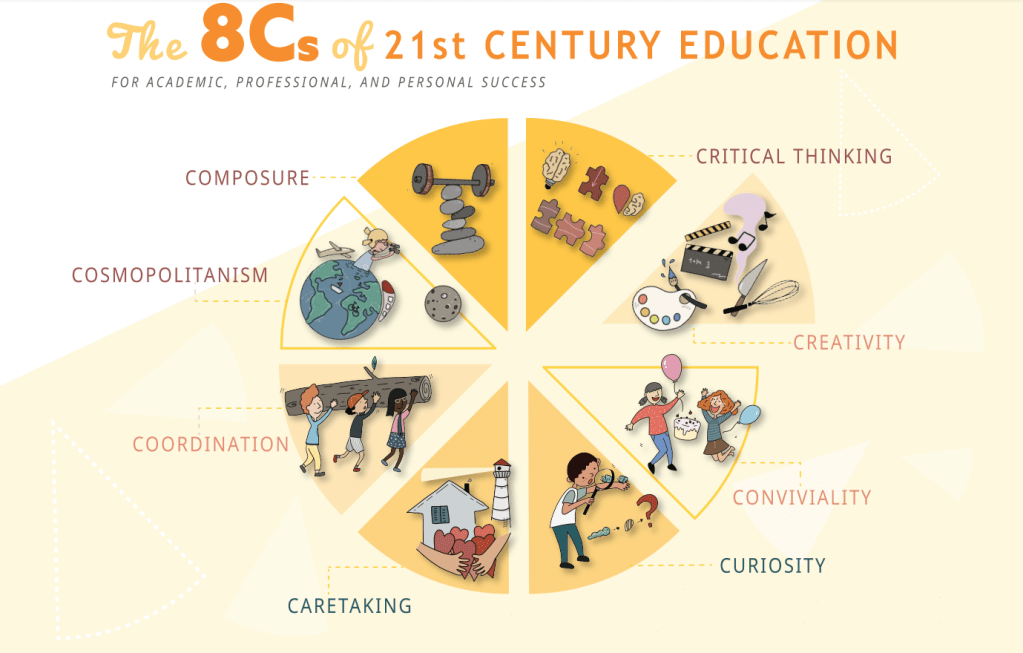
Curiosity
“Curiosity is, in great and generous minds, the first passion and the last.” -Samuel Johnson
It’s said that necessity is the mother of invention.
We’d suggest that curiosity is its father. The simple act of wondering if something could be done better – the simple act of fantasizing, dreaming, imagining – is at the root of countless human endeavors that have generated tremendous, timeless value in people’s lives.
Fostering a climate of genuine wonder and inquiry with as broad a view of possibility as can be justified is what youth education calls for. Before every answer comes a question, and in our age of exponentially increasing amounts of data and historically unprecedented access to it – in our age of burgeoning empowerment and lightning change – finding good questions is more necessary than ever.
Keep the scope of your classes broad and remind students that no one has all the answers. Life is a brilliantly colorful, fascinatingly messy, unspeakably beautiful process of learning and creation. Have fun exploring the world with your class and help them to hone their abilities to better explore it themselves.
Some of the keys to welcoming curiosity into your classroom are:
- Encouraging earnest questions;
- Asking earnest questions yourself;
- Showing your own deep curiosity about what it is that fascinates and energizes you personally;
- Demonstrating an appreciation for the complexity of things, regularly running the risk of giving answers that you fear are ‘too complex’ for the age group you are working with;
- Finding ample time to focus on activities that have no ‘right’ or ‘wrong’ answer;
- Showing your students that you’re not afraid to make mistakes, learn from them, and share your findings just as you hope they will.
Critical Thinking
“Too err is human, to forgive, divine.” -Alexander Pope
Students expect to be corrected and will eventually grow in proportion to the height of the standard to which they are consistently held, insofar as their innate potential allows and their environment supports their growth. And yet, as Socrates posited over two millennia ago, everyone does what they believe is good. It can be challenging for anyone to grapple with the depths of their own folly.
With regular healthy doses of positive reinforcement in an environment brimming with positive energy, they can feel encouraged to continue to learn and grow far beyond the concrete confines of our classrooms. Of the many fundamental lessons they will learn are that nobody is perfect and there are better and worse ways to think of things and perform tasks.
At the heart of a truly democratic society is the idea that we are capable of ultimately guiding ourselves, collectively sharing the burdens of policy, governance, and social development. The contagion of liberty continues to spread, and helping our students develop clear, logical thinking is all the more important in our age of flashy clickbait media, powerful corporate agendas, and the unprecedented ability to access and channel the incredible
streams of available information.
Some of the keys to welcoming critical thinking into your classroom are:
- Demonstrating your willingness to be critiqued and corrected by your students;
- Showing how much you enjoy the process of open collective analysis;
- Approaching definitions from both a practical and a philosophical perspective;
- Reminding students that, for example, ‘family’, ‘country’, and ‘money’ are all narrative concepts – ideas – rather than simple, discreet natural phenomena;
- Asking questions regularly that require higher-order thinking, rather than merely recitation and identification.
Composure
“All of Greece is a stage, and every Greek’s an actor.” -Juvenal
Generally speaking, people tend to feel first then think.
Young learners are especially emotional beings. The younger the subject, the more their emotions tend to dictate their actions. With great examples, enough time to develop mutual trust and respect, and the occasional release of appropriate, clearly understood, fairly administered unpleasant consequences, young learners will naturally develop useful techniques to help them learn how to cope with and even use their more challenging
feelings positively.
One of the most fundamental life skills we can engender in our students is that of taking everything in stride and moving on positively and energetically. Part of moving on is, corporeal as we are, necessarily physical. Kinesthetic intelligence tends to find itself stuffed into the rather small box of a twice-a-week P.E. class where kids play lackluster volleyball or jog for a few minutes. Better would be adding consistently mindful movement, posture, and breath work in all of our classes.
Sitting properly is important enough to be a mainstay of
every class. Educating our bodies is an excellent way to increase motivation, maintain active attention, center the educational process closer to each student, and help engender better lives outside of the classroom.
In our age of flashy cell phone games, ubiquitous hunchbacked scrolling, sugary drinks and fatty processed McFoods, where feeling good now has become almost sanctified by the commercial interests that dominate modern society. In our age of global high-stakes standardized assimilation and regurgitation that represents so much of our schooling, spending time on managing, maintaining, and moving our bodies well is more important than ever.
After all, you never get a second chance at a first impression, do you?
Some of the keys to welcoming composure into your classroom are:
- Always maintaining a composed demeanor yourself, no matter how frustrated you might be;
- Dressing in a ‘business-casual’ way yourself;
- Insisting students always sit at least reasonably well;
- Complimenting neatness and tidiness;
- Engaging the class in skits, plays, dances, and games that require movement as well as language.
Creativity
“Creativity is intelligence having fun.” -Albert Einstein
Educational methodologies of the modern age, broadly speaking, are directly related to those of the capitalist 20th century, which found their genesis in a world where training moderately capable, reasonably literate, comfortably compliant workers was the goal of the influential policy-forming industrialists.
Not much has changed.
One can easily see the historical roots of our neat rows of desks, dry technical textbooks, and fairly large groups of placid listeners patiently waiting for the bell, attending to the boss’s commands, raising their hands for permission to open their mouths or use the bathroom, compelled under the force of law to attend, left with little choice but to attempt to excel at whatever mundane task they are given.
As the issues we face are becoming increasingly subtle, complex, and critical, dynamic thinking and creativity are called for. This would be true even were we not living through a cataclysmic ecological disaster – the 6th mass extinction event, all but certainly caused by our extractive global economy. For one stark example, read David Wallace-Wells, The Uninhabitable Earth (2019).
Our schooling must reflect the needs of our society, and those needs were very different than the ostensible needs of the capitalist robber-baron policy-makers to whom much of our present educational system finds its genesis. They are even more different now.
As robotic automation began replacing much of our repetitive work, and AI encroaches on ever more, the quantity of information is rapidly increasing, its accessibility is broader than ever, and more and more of us are coming to believe that an interesting, comfortable, meaningful life is not only possible, but may be better thought of as a fundamental human right, a truly empowering, democratic educational experience is called for.
Instead of emphasizing rote repetition (though copying and repeating will always have a key role), challenge and encourage students to generate unique sentences and zany scenarios using the vocabulary, grammar, and sentence patterns they will be engaging. Through colorful art, fun physical activities, creative DIY, and playful sentence building, learners will find themselves more motivated while better absorbing the material. They’ll begin to see that the goal of a great education isn’t as simple as always not being wrong.
Indeed, there is no such thing as categorically ‘right’ or ‘wrong’ art, and if life lived well is indeed a work of the highest art, then our typical educational obsession solely with avoidance of error does our students a serious disservice.
Some of the keys to welcoming creativity into your classrooms are:
- Weekly artwork and/or DIY projects;
- Mind maps and other connective, open, non-linear activities;
- Creating a colorful, engaging learning environment;
- Encouraging students to have fun and play with language;
- Being spontaneous and surprising them as often as you can;
- Sharing your favorite artwork and personal creative endeavors.
Conviviality
“Because every single one of us has something to say to the others, something that deserves to be celebrated or forgiven by others.” -Eduardo Galeano
Our journey through life is all the better the more we enjoy it together. Making our students’ personal growth enjoyable is natural because we enjoy the process of helping them grow. That’s why we chose this lifestyle as educators.
Cultivating an atmosphere of consistently positive personal growth is challenging, as we balance concrete curricular demands; primary caregivers’ values and perceptions; the unique needs of each of our students; administrative and governmental hurdles; the trials in our own personal lives; our human tendency to oversimplify incredibly complex and multifaceted situations in order to proceed promptly and in an acceptable direction; and the inevitability of imprecisely evaluating our own understanding, influence, and ability.
Celebrating our trails and trials with a smile can help. Celebrating every good step in the journey is the sort of attitude that lends itself to excellence. Part of a great education is occasionally engaging in heartfelt, deep discussions. Balancing those with a mainstay of lighthearted, easygoing fun is the art of youth education.
Cultivating an atmosphere of happy, smart growth is the goal.
Some of the keys to welcoming conviviality into your classroom are:
- Have fun together with your students with interesting activities;
- Give lots of opportunities and leeway for students to play with lessons in their own ways;
- Joke and play with them whenever and however possible;
- Take the time to celebrate as much as possible – not just formal occasions;
- Be silly, snarky, zany, and surprising. That’s an order, soldier!
Caretaking
“Be kind, for everyone you meet is fighting a hard battle.” -John Watson
As mentioned earlier, a child’s personality is particularly cultivated in infancy. We’re not of the mind that we can really ‘teach compassion’ by explaining why it’s nice to be nice. However, we can help show how to do what we know we should: take care of each other.
In the modern capitalist world, we’re often reminded that much as in the lives of our ancient hunter-gatherer ancestors and the early primates before them from whom which we and our furry cousins all evolved, competition is an inevitable aspect of success: but such competition only ultimately benefits humanity if it is framed within a habitually compassionate lifestyle of earnestly doing our best by and for others.
Kropotkin’s Mutual Aid: A Factor of Evolution (1902) does magnificent work showing how cooperation is not a fragile exception to the need for competition, but a foundational drive that has continually shaped communities human and non-human alike. Urging our students to leave every place better than they found it, while making sure we show them how such a philosophy works in practice, we can help them help others wherever they go.
This is a good place to discuss the difference between being ‘compassionate’ and just being ‘nice.’ The latter can, for our purposes, be seen as a surface-level absence of hostility. It’s usually nice when a receptionist smiles blithely instead of throwing a stapler at you when you enter the lobby. But a mere absence of hostility isn’t sufficient to cultivate a convivial community – though it is, typically, a great start.
It is important to remember that being overly friendly and accepting of students’ work is not ideal. While we strive to forge horizontal, fundamentally respectful relationships where students are always encouraged to voice their opinions and suggest a better way, we are not suggesting that we celebrate everything students produce, nor are we suggesting that a student’s tears should be a free pass out of a clearly explained, expected consequence.
Being truly compassionate is balancing present needs with those of the future, not giving undue weight to emotional concerns over practical ones; it’s about those who are present with us and those many unseen whose lives we affect – very much including the people that our students will grow up into being.
Our responsibilities to our increasingly global community extend far outside the walls of our classrooms. While it’s necessary to show our awareness of and attentiveness towards our students’ immediate physical and emotional needs, it’s crucial to help foster in them an awareness of how intimately intertwined – and desperately imperilled – our global community is.
Coordination
Some of the keys to welcoming caretaking into your classroom are:
- Sourcing products locally, from employee-owned and operated enterprises;
- Developing your students’ class consciousness;
- Working with your community to make your shared space lively and pleasant;
- Spending the time to share meaningful, insightful stories;
- Ensuring students clean up after themselves and always leave places in a responsible fashion;
- Always maintaining a neat, orderly, sanitary classroom;
- Encouraging students to sneeze into the crook of their elbows, not their hands;
- Encouraging teamwork and win-win scenarios rather than only zero-sum competitions;
- Making sure they know without a doubt that you care very much for them.
Cosmopolitanism
“I am a citizen of the world.” -Diogenes
The heart of any healthy democratic society is widespread, informed, willing participation. When students understand how decisions are made, how systems function, and how values shape both, they are better prepared to become active, constructive forces in their families, communities, and the wider world.
Classrooms must not persist as the instruments of indoctrination they so often are. A Taiwanese friend of mine once characterized the key difference between education and brainwashing is that the former is inclusive and the latter is exclusive.
At the same time, avoiding meaningful discussions of politics, governance, and human purpose would leave students unprepared for the world they are already entering. Anyone old enough to ask an honest question deserves an honest answer.
To help students navigate that world, we can offer them a simple framework:
- Science asks: What is true?
- Religion asks: What matters?
- Art asks: What is meaningful?
- Politics asks: What should we do together?
These are by no means isolated domains. They are different ways of engaging with reality and with one another. When students explore how they connect, they begin to see that civic life is not just about procedures, but about the values and judgments that give those procedures life.
We feel that cosmopolitanism is the recognition that we are shaped by our particular communities, yet responsible to a broader human world. It asks us to remain curious about other ways of living, to respect systems not our own, and to participate thoughtfully in shared problems that should bring us together across time, walls, and borders.
Engendering the capacity for wise decision-making is one way to understand the teacher’s task. Creating the conditions in which those decisions can matter is one way to understand the work of leadership. When students learn to balance their own needs and ideals with a genuine respect for others, they begin to see themselves not only as members of a nation, but as participants in our vast shared human story.
Some of the keys to welcoming cosmopolitanism into your classroom are:
- Lively discussions of local and global issues;
- Respecting self-determination and social conventions;
- Conducting your classes democratically, with open discussions;
- Regularly using maps to help contextualize your discussions;
- Encouraging students to make their own maps and charts;
- Sharing stories of (your own!) travels and worldwide experiences;
- Assigning projects and activities that help students engage with the world around them.

